Tracing a claim to its source
A citation makes a claim traceable. It doesn't mean anyone checked it. Make the evidence easy to inspect where the claim is read.
- Problem
- Sources are linked, but the words behind the claim stay hidden.
- Pattern
- Show the quote beside the claim. Highlight it in the original source.
- Tradeoff
- More space, less hunting. Use it for claims that matter.
Inspecting a screening decision
In Periscope, a model screened research papers against a set of rules. Every decision came with a rationale. Because a rationale can sound settled even when it isn't, the card also showed the quote supporting it—and any quote that argued the other way.
This fictional example concerns a streaming app’s recommendation explanations. The model excludes it under E1 because it reports no user study of the explanations.
What changes
The words are visible beside the decision, with the surrounding text immediately below. Evidence and counter-evidence are both available.
What it doesn't solve
A quote can exist and still fail to support a claim. Highlighting makes verification cheaper; it cannot replace judgment.
Check the counter-evidence. The explanation card shows that an interface exists, giving the reviewer a reason to check the exclusion. But describing an interface is not the same as running a user study. The evaluation measures recommendation accuracy, so this quote does not overturn the exclusion for no user study of the explanations.
In other products: citations that can remain unopened
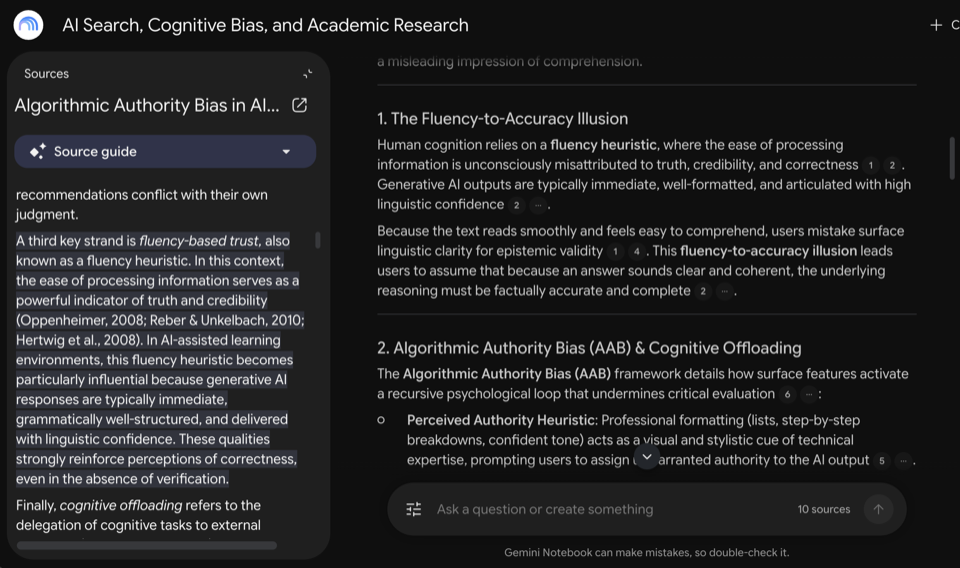
NotebookLM makes citations available beside the answer, but the reader can continue without opening them or inspecting the supporting evidence.
The simplified demo below shows that distinction. Opening a citation brings the quoted passage into view. The reader still has to judge whether it supports the claim.
Starts with no citation opened.
Starts with citation 1 opened, with its passage highlighted.
When to use it
For decisions, numbers, and claims likely to be repeated. For low-stakes background, a citation may be enough.
Where it fails
Found isn't supported. The matched words may be authentic without proving the rationale.
Matching can be loose. Ignoring punctuation and whitespace helps with messy PDF text, but subtle differences can change meaning.
The source may be partial. An abstract may omit a comprehension study described elsewhere in the paper. Its absence from the abstract is not enough to establish its absence from the full paper.
Counter-evidence is model-selected. If the model omits it, the interface can't show what was missed.
Space has a cost. Two quotes are worthwhile for an exclusion decision; on every sentence of a long answer they can become noise.